← all work
live · web · 2026 · founder, product + engineering
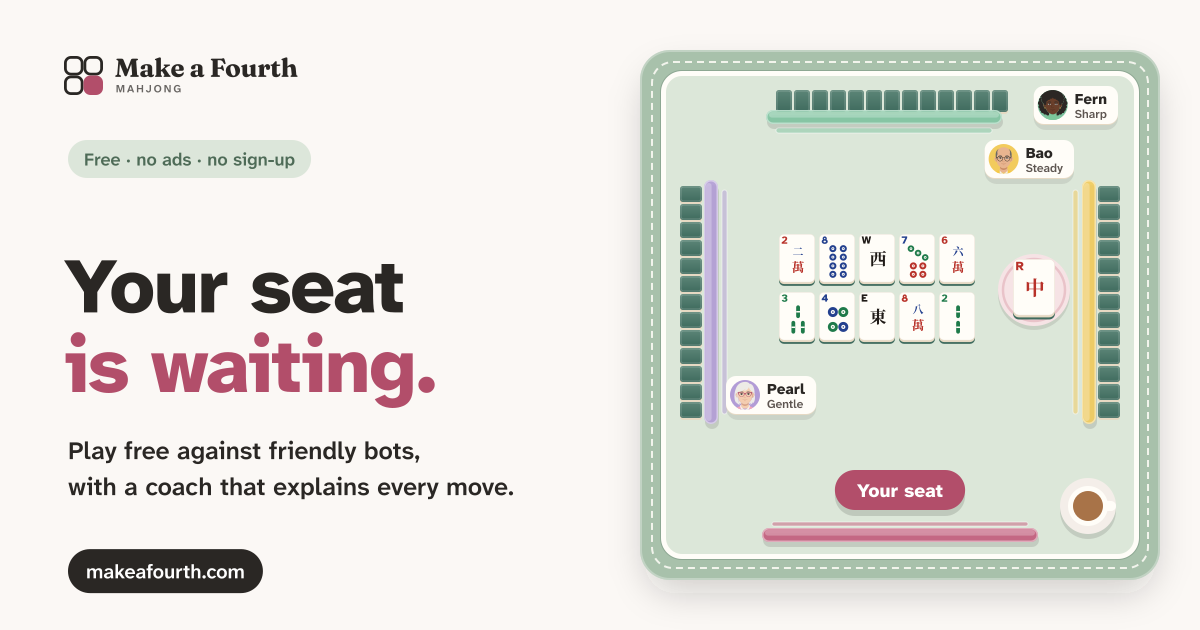
Make a Fourth: free mahjong vs friendly bots, coached on your device.
free mahjong vs bots, with a coach
 Visit makeafourth.com ↗
- 4mahjong rulesets
- 18free American lessons
- 7 daysfirst commit to launch
- 1,000bot games per ruleset before go-live
01 · the problem
Mahjong needs four players. Beginner classes in the US are selling out, with waitlists, and between classes a learner still needs three other people to practice with. The free, unlimited app I compared against shows ads. I wanted a place to make a fourth: sit down, play a hand, and learn from it.02 · what I built
Make a Fourth runs in the browser. You play against three friendly bots in seconds, with no sign-up, no download and no ads. The game engine is one TypeScript package that runs on the player's device; friends' tables use a room server on Cloudflare Durable Objects that holds the wall and sends each player only their own view, so nobody can peek.
- Four rulesets: American, British, Chinese Official and Riichi, each on the same shared table.
- A coach that explains every move, and 18 short interactive lessons for American mahjong, all free.
- Friends' tables by private link, with bots filling empty seats.
- Plus, a paid plan for software features only: the coach on every game, game review and a sharper bot. Teachers get free class pages and homework hands their students can play.
- Next.js
- Cloudflare Workers
- Durable Objects
- Neon Postgres
- Stripe
- TypeScript
03 · how AI helped
- Where I chose not to use AI: the coach is not an LLM. It is a rule-based engine that scores each tile and reads the hand, the same code that drives the bots. Games and coaching run on the player's device with no server and no AI calls, so a player costs almost nothing to serve and a lifetime plan can stay honest.
- I built it with Claude Code as an orchestrator. One command plans the work, opens one git worktree per track (engine, game UI, payments, rooms, growth, teachers) and runs a subagent on each in parallel. A reviewer agent checks every branch, and nothing merges to main until review, tests and typecheck pass.
- The work didn't depend on one model. The plan, the rules file, the tests and a reviewer agent lived in the repo, so when a model hit its quota mid-run, a full design rebuild carried on from Claude to Z Code to DeepSeek Harness and back to Claude, to the same standard and with nothing dropped.
- Before launch, five agents audited the site in parallel against SEO, security, performance, reliability and accessibility rules, and their fixes landed as one reviewed change.
04 · what changed
The site went live at makeafourth.com on 25 Nov 2026, seven days after the first commit, with all four rulesets playable. Each ruleset went live only after 1,000 bot-only games with no illegal move or stall. It is entered in the Ship or Die $100K Hackathon, which ranks entries by verified profit until 16 Dec, so the free plan stays free and Plus sells software, never lessons.05 · what I'd do differently
Running many agents in parallel cost me work once: on 24 Nov, merging the teacher features quietly dropped a design I had already approved. I now run a guard before every merge that fails if a branch would remove lines none of its commits meant to remove, and I would build that check on day one next time.